Un prompt de branding utile transforme un brief de marque en décisions visuelles répétables : audience, positionnement, palette, composition, rôle de la référence et éléments à finir dans un outil de design.
TL;DR : transformez le brief en couches contrôlables
- Brand moodboard: keep the brand role, audience, palette, reference handoff, and output rule stable before changing style.
- Identity poster: keep the brand role, audience, palette, reference handoff, and output rule stable before changing style.
- Product campaign: keep the brand role, audience, palette, reference handoff, and output rule stable before changing style.
- Logo direction board: keep the brand role, audience, palette, reference handoff, and output rule stable before changing style.
Formule de prompt de branding
| Layer | What to write | Why it matters |
|---|---|---|
| Brand role | Moodboard, identity poster, logo direction, campaign, profile visual, or social template. | Each brand job needs a different review check. |
| Audience | Target buyer, positioning, tone, and market signal. | This avoids generic brand styling. |
| Visual system | Palette, material, grid, type direction, motif, and photography style. | It keeps later assets related. |
| Reference | What the uploaded image controls and what can change. | Identity and packaging stay stable. |
| Output | Ratio, blank logo area, no final text, no watermark. | Brand images usually need editing after generation. |
| Review | Tone, hierarchy, palette, logo space, or identity drift. | Iteration becomes easier to diagnose. |
Matrice de scénarios
| Brand job | Prompt focus | Reference image | First fix |
|---|---|---|---|
| Moodboard | Palette, materials, photo language, type direction. | Use when current brand surfaces exist. | Make it more ownable. |
| Identity poster | Hero mark area, negative space, campaign tone. | Use when a mark shape must stay stable. | Fix logo zone and text policy. |
| Product campaign | Product silhouette, material, audience, copy-safe space. | Use when packaging must remain recognizable. | Fix product drift. |
| Personal brand | Face, wardrobe, crop, platform format. | Use when the person must stay recognizable. | Fix face drift. |
| Logo direction | Simple mark language, spacing, contrast. | Use for direction, not final trademark work. | Remove tiny fake text. |
Blocs de prompts de branding à copier
Blocs de prompts de branding à copier
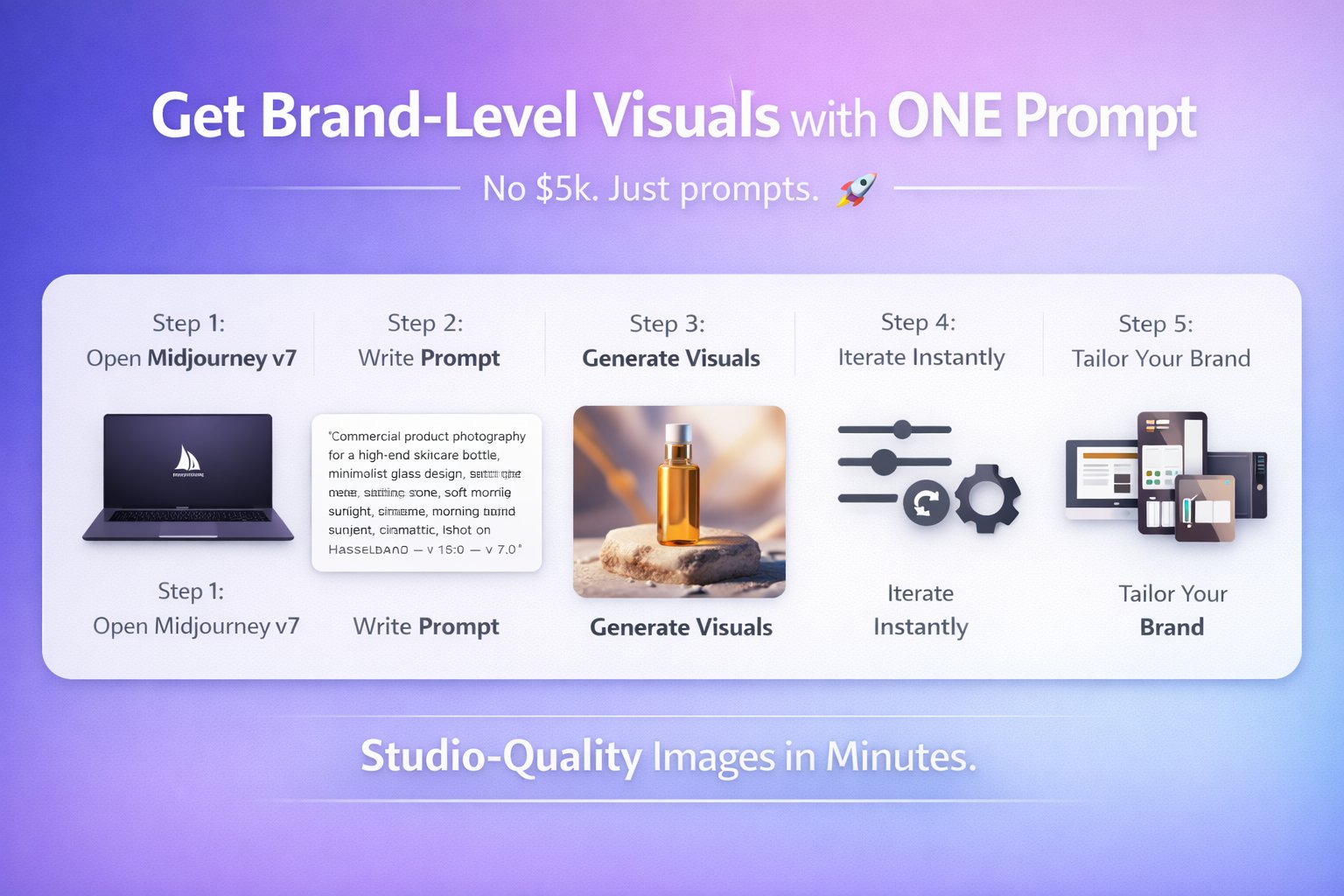
- Brand moodboard: Create a premium brand moodboard for [brand], audience [audience], positioning [positioning], palette [colors], typography direction [type style], materials [materials], 3x3 editorial layout, clear labels as placeholder blocks only, no readable final copy, 16:9 aspect ratio.
- Identity poster: Modern editorial branding poster for [brand], hero symbol inspired by [visual cue], strong negative space, palette [colors], refined grid system, luxury campaign lighting, logo area left blank for later design, 4:5 aspect ratio, no watermark.
- Product campaign: Premium campaign image for [product], brand tone [tone], audience [audience], background [setting], controlled shadows, consistent palette [colors], room for headline and logo added later, commercial photography realism, 9:16 aspect ratio, no generated text.
- Logo direction board: Explore three logo direction thumbnails for [brand], simple geometric mark language, monochrome plus one accent color, clean spacing, flat presentation board, no final trademark claim, no tiny unreadable text.
Exemple complet : du brief au premier prompt de campagne
Brief brut
Boutique sparkling-water launch visual: design-aware urban audience, crisp optimistic positioning, silver, cobalt, and citrus green palette, recognizable bottle shape.
Prompt version 1
- Premium product campaign image for a boutique sparkling-water bottle, design-aware urban audience, crisp optimistic brand tone, silver cobalt and citrus green palette, clean studio stage with subtle condensation, bottle centered with strong silhouette, controlled shadows, room above and right for headline and logo added later, commercial photography realism, 4:5 aspect ratio, no generated text, no watermark.
Diagnostic du premier résultat
Nommez l'échec avant de réécrire : identité, hiérarchie, style générique ou texte cassé, puis corrigez un seul contrôle.
Erreurs et corrections
| Failure mode | Fix first | Avoid |
|---|---|---|
| Generic brand | Add audience, positioning, palette, material, and one distinctive cue. | More vague adjectives. |
| Broken text or logo | Reserve blank space and add typography later. | Exact final copy in generation. |
| Identity drift | Attach a reference and name what it controls. | Changing the whole direction. |
| Pretty but unusable moodboard | Add channel, board layout, and decision labels. | More unrelated aesthetics. |
| Inconsistent campaign | Duplicate the solved prompt and swap variables. | Rewriting every asset. |
Utiliser les prompts de branding dans Vogue AI
Utiliser les prompts de branding dans Vogue AI
- Use GPT Image 2 when instruction control is the main risk.
- Use Nano Banana for quick image-to-image variations.
- Use Midjourney for mood-forward visual exploration.
- Keep final typography outside the generated image.
- Save the winning prompt by job, ratio, palette, and reference rule.
FAQ
Puis-je copier ces prompts directement ?
Oui. Copiez le bloc anglais, remplacez les variables entre crochets et gardez la structure stable au premier rendu.
Un prompt doit-il générer le logo final ?
Non. Utilisez-le pour explorer une direction, puis finalisez le logo, le lockup et la typographie dans un outil de design.
Quand utiliser une image de référence ?
Quand l'identité compte : produit, packaging, visage, symbole, palette ou système de mise en page.
Quel modèle essayer en premier ?
Choisissez selon le risque : GPT Image 2 pour le contrôle, Nano Banana pour les variations, Midjourney pour le mood.
Comment garder une campagne cohérente ?
Enregistrez le prompt qui fonctionne, puis changez seulement ratio, canal, produit ou décor.
Que faire après un mauvais premier résultat ?
Nommez l'échec avant de réécrire : identité, hiérarchie, style générique ou texte cassé, puis corrigez un seul contrôle.